Table of Contents
ToggleThe MOBA wars have raged for nearly two decades, and the central question remains unchanged: League of Legends or Dota 2? Both games have evolved dramatically since their debuts, each carving out massive playerbases and dominating different regions of the competitive scene. In 2026, the gap between them has narrowed in some areas and widened in others. If you’re deciding which to invest your time in, or whether to juggle both, understanding their fundamental differences is essential. This comparison breaks down the mechanics, learning curves, esports ecosystem, and community culture to help you make an informed choice.
Key Takeaways
- League of Legends vs Dota 2 represents a choice between accessibility with League’s readable mechanics and faster matches versus Dota’s complexity and longer strategic depth, each rewarding different player philosophies.
- League of Legends dominates casual play with ~160-180 million monthly actives, instant queue times, and a gentler learning curve, while Dota 2’s smaller 10-15 million monthly base excels for players seeking mechanical mastery and item flexibility.
- Esports careers diverge significantly: League’s franchised regional system offers stable income and clear progression, whereas Dota 2’s International delivers higher prize pools ($30+ million) but less consistent income between tournaments.
- League’s standardized item builds and symmetrical map design create predictable macro gameplay and faster feedback loops, while Dota’s asymmetrical map and situational itemization reward positioning awareness and adaptive strategy.
- Both games remain free-to-play with cosmetic-only monetization, though League feels more budget-friendly with less aggressive cosmetic rotation, while Dota employs more frequent sales and battle pass variations that create different spending patterns.
Core Gameplay Mechanics: What Sets Them Apart
League of Legends and Dota 2 occupy the same genre but play like entirely different games. The mechanics define everything else: how you build items, how heroes scale, how fights flow. Understanding these differences is the foundation for deciding which game clicks with you.
Hero And Champion Design Philosophy
League champions are designed with clarity and counterplay at their core. Every ability has a clear telegraph, hitbox, and counterplay pattern. Riot’s philosophy emphasizes “readable” gameplay, when an opponent uses an ability, you should understand what happened and why. Champions have relatively shorter ability cooldowns, leading to faster gameplay and more frequent ability usage.
Dota 2 heroes embrace complexity without apology. Abilities are often less telegraphed, cast points vary dramatically, and there’s less concern with “readability” in favor of mechanical depth. A support hero might have a 4-second stun, while a carry could have a 10-second ability cooldown. The game doesn’t hold your hand, it rewards those who grind the knowledge.
Design philosophy translates to playstyle differences. A League teamfight revolves around burst windows and cooldown management. A Dota teamfight can hinge on a single 3-second stun or channeled ability landing correctly. Neither is objectively better, they’re fundamentally different games wearing similar clothes.
Map Layout And Objectives
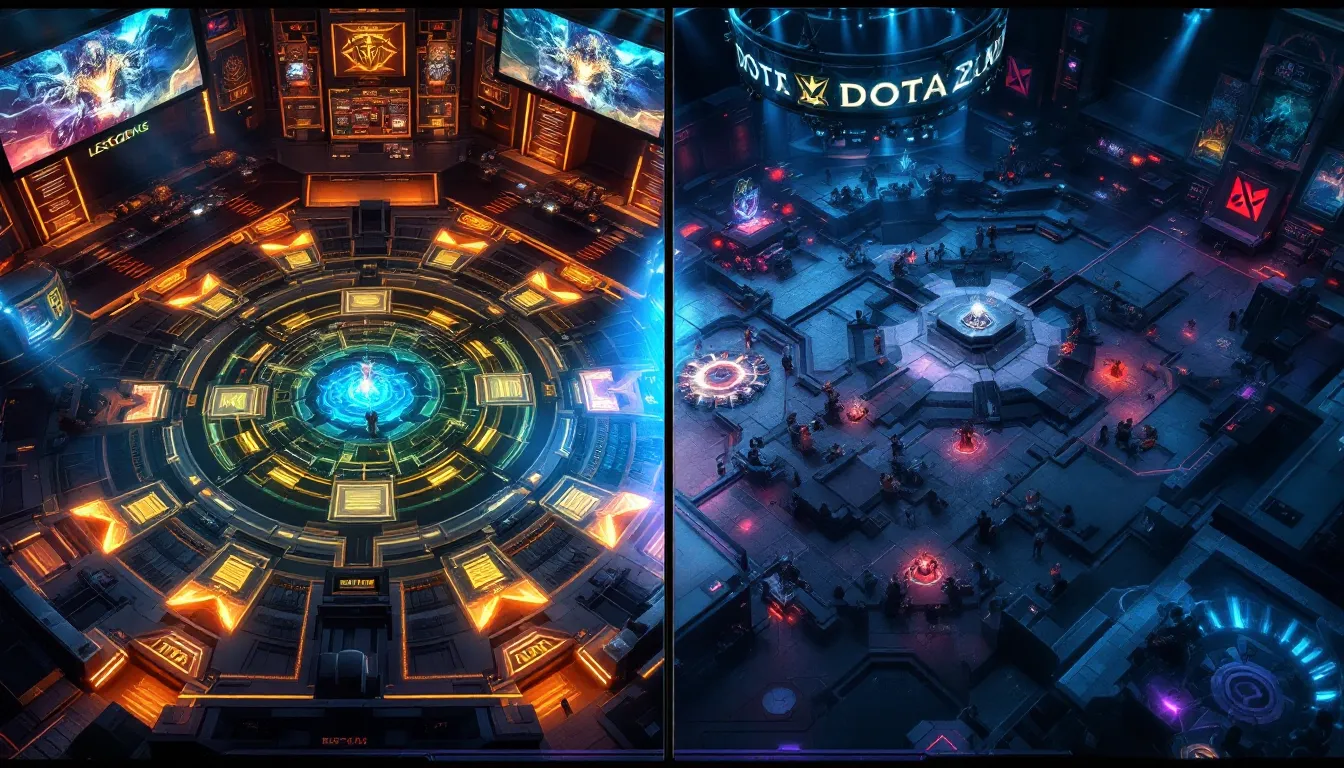
League’s Summoner’s Rift is designed for symmetry and clarity. The three lanes mirror each other perfectly, objectives have clear-cut purposes, and macro gameplay revolves around turret destruction and resource management. Baron Nashor and Dragons provide timed buffs that grant temporary advantages. The river moves freely, and vision control matters but doesn’t dominate the game.
Dota 2’s map is asymmetrical. The Radiant side has inherent advantages in certain areas: the Dire side has others. Trees block vision aggressively, creating fog-of-war situations that reward careful positioning and positioning prediction. The map contains several neutral objectives and roshan pit (the Dota equivalent of Baron, but respawns unpredictably). Micro-positioning matters far more.
The asymmetry creates different strategic depth. League rewards macro planning and objective timing. Dota rewards positioning awareness and unpredictability. Players who love calculated teamfight setups might prefer League: those who enjoy reactive, chaotic gameplay gravitate toward Dota.
Item Building And Economy Systems
League’s item system is highly standardized. The vast majority of champions follow core item paths, ADCs build the same “mythic” and utility items, supports follow predictable upgrade chains. Items grant clear stat bumps and passive effects. League of Legends trends 2026 show meta builds shifting with seasonal patches, but the fundamental economy structure remains. Gold generation is stable, and farming patterns are predictable.
Dota 2’s economy is less forgiving and more diverse. Items are situational to an extreme degree. A mid-laner might need a Linken’s Sphere against one team and a Black King Bar against another. The item pool is massive, and there’s genuine room for creative builds. Gold advantage translates more directly into power, and a 2,000-gold deficit feels significantly more punishing. Farming patterns are more varied depending on hero role and matchup.
Item flexibility shows personality differences between the games. League’s more standardized approach makes it easier to theory-craft and optimize. Dota’s flexibility rewards adaptability and game knowledge. If you like following proven builds, League wins. If you love experimenting and countering builds on the fly, Dota excels.
Learning Curve And Accessibility For New Players
Both games are overwhelming to newcomers, but they’re overwhelming in different ways. The path to competency differs significantly.
Beginner-Friendly Features
League of Legends for beginners is more forgiving in its initial learning phase. The game limits new accounts to a smaller champion pool, reducing decision paralysis. Tutorials are more structured, and the client walks you through objectives clearly. Wards have a clearer visual indicator on the minimap, and vision denial is less punishing. How to play League of Legends guides are abundant and highly accessible.
Dota 2 throws you into the deep end. New players face the entire hero pool immediately and get no hand-holding on itemization. The tutorial exists but is barebones. Denying enemy creeps (killing your own minions to deny enemies gold) is a core mechanic new players don’t understand. Spell hotkeys vary per hero, adding muscle-memory friction.
For pure accessibility, League wins decisively. A new player can reach “competent” status faster. Dota demands more baseline knowledge before the game becomes enjoyable. But, this accessibility trade-off means League’s skill floor is higher in terms of decision-making depth from the start.
Skill Ceiling And Long-Term Depth
League’s skill ceiling is incredibly high once you move beyond champion mechanics. Macro gameplay, wave manipulation, and teamfight positioning create endless depth. League of Legends techniques such as wave management and roaming patterns separate hardstuck players from masters-tier competitors. The learning curve is gentler early but steeper long-term.
Dota 2’s skill ceiling operates differently. Early-game mechanics matter more, last-hitting is significantly harder due to varied attack speeds and cast points. Deny mechanics add complexity immediately. Spell positioning, animation canceling, and hero-specific mechanics create a high floor. Long-term mastery involves understanding the absurdly complex item interactions and hero synergies.
Both reach similar ceilings eventually, but the climb feels different. League’s path is more linear and forgiving: Dota’s is steeper but more rewarding for those who grind it.
Esports Scene And Competitive Landscape
Esports infrastructure is where these games diverge most dramatically in 2026. The competitive ecosystem shapes which game feels more “alive” to fans.
Tournament Structure And Prize Pools
League of Legends esports operates through regional franchised leagues (LEC, LCS, LCK, LPL). Riot invested heavily in traditional sports infrastructure, with teams having permanent spots and guaranteed paychecks. The Worlds tournament remains the flagship event with multi-million dollar prize pools. The 2025-2026 season continues this franchise model with regional playoffs feeding into Worlds.
Dota 2’s esports scene is more diverse and decentralized. Valve runs The International annually, which dwarfs Worlds in prize pool (crowd-funded battle passes inflate the pot to $30+ million). But, regional competitions vary wildly in stability and prize support. T1 teams might earn more from International runs than from regional play. Some regions lack consistent tournament infrastructure.
For players seeking stable income, League’s franchised model is superior. For players chasing life-changing windfalls, Dota’s International offers unmatched rewards. Esports coverage from Dot Esports tracks both scenes extensively, but the competitive structures cater to different professional mindsets.
Regional Dominance And Global Viewership
League dominates in viewership consistency. LCK (Korea) and LPL (China) draw massive audiences, with Worlds regularly topping 5 million concurrent viewers. The game maintains strong appeal in Europe and North America through established franchises and familiar team brands. Peak viewers are predictable and sustainable.
Dota 2’s viewership spikes dramatically during The International. Outside that window, regional scenes vary significantly. Chinese Dota is rabidly popular: European and American scenes are softer. Viewership is more volatile, making esports careers less stable outside International years.
For narrative consistency and team brand building, League edges ahead. For raw spectacle during peak moments, Dota offers unmatched theater.
Community, Population, And Player Base
Raw player numbers matter, but so does the character of those communities.
Active Player Numbers And Server Health
League of Legends maintains approximately 160-180 million monthly active players across all regions as of 2026. Queue times are instant on stable servers, and server health is generally excellent. Ranked matchmaking is robust, with clear tiers from Iron to Challenger. The playerbase is stable and continues to grow in emerging markets.
Dota 2 reports around 900,000-1.2 million concurrent players daily, translating to roughly 10-15 million monthly actives. This is substantially smaller than League, but the game remains healthy. Queue times can stretch longer during off-hours in smaller regions, and some servers experience seasonal player fluctuations. The playerbase is more concentrated in China, Eastern Europe, and parts of Southeast Asia.
League’s advantage in playerbase size is undeniable. Faster queues, more ranked tiers, and healthier matchmaking are direct results. Dota’s smaller base doesn’t mean the game is dying, it’s thriving in committed regions, but the populations aren’t close.
Community Culture And Toxicity Levels
Both games struggle with toxicity, but manifestations differ.
League’s community skews younger and more volatile. Flamers are more vocal in all-chat, and muting becomes a necessity. But, Riot’s moderation has improved significantly, with new players reporting fewer tilted veterans. League of Legends communities on Reddit and Discord are generally helpful even though toxic pockets. The lower average age means more emotional swings.
Dota 2’s community is more cynical and jaded but arguably less emotionally volatile. Toxic players exist, but they lean toward sarcasm rather than screaming. Smurfs are more prevalent (professional players boost accounts for fun), which frustrates new players. The community’s Eastern European and Russian presence adds different cultural communication styles that can feel harsh to Western players.
Neither community is objectively better. League feels more youthful and immediate in its toxicity: Dota’s feels more resigned and sarcastic. Thick skin helps in both, but better muting tools and newer player bases (in emerging regions) have improved the overall tone.
Monetization And In-Game Cosmetics
Both games are free-to-play, but how they monetize differs substantially.
Battle Pass And Seasonal Systems
League’s monetization revolves around cosmetics and battle passes. The Pass of Ascension (League’s seasonal battle pass equivalent) costs 1,650 RP ($12-15 USD) and grants cosmetics, blue essence, and wards. Multiple battle pass variants exist for specific events. Seasonal cosmetics drive FOMO, and rare skins from previous seasons command respect. The game rarely has cosmetics on sale during their season.
Dota 2’s monetization is more aggressive but paradoxically feels less intrusive. The Dota Plus subscription ($4 monthly or $40 yearly) grants cosmetics, shards for specific cosmetic unlocks, and a battle pass. During The International, the battle pass inflates to $20 due to crowd-funding mechanics, but it’s optional. Importantly, Dota rotates cosmetics aggressively, meaning almost everything comes back on sale within months.
Pricing And Value For Money
League’s individual cosmetics are expensive. Skins cost 975-1820 RP ($7.50-14 USD), and prestige variants cost significantly more. But, you’re not forced to buy battle passes, cosmetics are purely optional, and seasonal currency keeps F2P players in the mix. The value proposition is “pay for aesthetics, zero pay-to-win.”
Dota 2’s cosmetics are cheaper individually but the system is complex. Battle pass cosmetics unlock through progression, but premium cosmetics (Arcanas) cost $30-40. Treasure chests introduce gambling elements uncommon in League. The Dota monetization system feels more predatory to some, with more aggressive FOMO tactics.
For budget-conscious players, League feels more respectful. Dota’s seasonal cosmetics rotate, making it feel like there’s always another chance, but the up-front cost can sting. Neither game is pay-to-win, so the choice is purely aesthetic.
Performance, Graphics, And Technical Requirements
Technical accessibility matters for global audiences.
System Requirements And Optimization
League of Legends runs on anything. Minimum specs are ancient (Pentium 4, 512MB RAM), and the client has been optimized relentlessly since 2009. A mid-range laptop from 2015 runs League at solid framerates. Mobile ports (League of Legends: Wild Rift) bring the game to phones globally.
Dota 2 is more demanding but still accessible. Minimum specs are similar, but the Vulkan/OpenGL rendering pipeline demands more modern hardware for high framerates. The 2022 Source 2 engine update improved optimization, but a potato PC might struggle at 60 FPS on medium settings. Dota can run on integrated graphics but benefits from discrete GPUs.
For players in regions with older hardware prevalence (parts of Southeast Asia, India, Africa), League’s optimization is transformative. Dota’s requirements won’t exclude most players but create friction. This accessibility advantage contributed to League’s playerbase dominance in emerging markets.
Visual Fidelity And Art Direction
League of Legends shifted toward stylized visuals with recent map updates. The 2023+ Summoner’s Rift redesign introduced updated models, particles, and lighting while maintaining the cartoonish aesthetic. Cosmetics have incredible visual identity, legendaries feel genuinely different from base skins. The art direction is cohesive and instantly recognizable.
Dota 2’s Source 2 engine update (2023) brought graphical parity to modern standards. Visual fidelity rivals League, but the art direction remains grittier and less stylized. Cosmetics in Dota are less visually transformative, many legendary items add subtle effects rather than full model overhauls. The environments are beautiful but less readable during chaotic teamfights (spell effects blend into the map more easily).
Which Game Should You Choose?
The answer depends entirely on what you want from a MOBA.
Best For Casual Players
League of Legends is the clear winner for casual play. The onboarding is smoother, matches are faster (typically 25-35 minutes vs. Dota’s 30-45 minute average), and the learning path is gentler. You can jump in, play a few matches, and feel productive immediately. Champions feel immediately rewarding to play, and cosmetics feel earned and special.
Casual Dota players exist but are rarer. The game’s complexity and longer match times create friction. New players need 50+ games before the core loop feels fun rather than frustrating. Mobalytics tier lists and guides help, but even with external resources, the ramp is steep.
Verdict: League for almost all casual players.
Best For Competitive Ambitions
Both games support competitive excellence, but the paths differ.
League’s franchised ecosystem means aspiring pros have clear progression: solo queue → academy teams → LEC/LCS/LCK/LPL. The infrastructure is solid, and salaries at high levels are guaranteed. Grinding to Masters or Grandmaster legitimately opens doors.
Dota 2’s path is more chaotic. Solo queue grind matters, but sponsorships and team invites are less predictable. But, The International offers unmatched monetary rewards for those who place well. A talented Dota player could win more at one tournament than a League player earns in an entire year.
For stability and progressive career development, League wins. For potential life-changing paydays, Dota offers more ceiling. League of Legends ideas threads on Reddit discuss esports paths: Dota communities debate International qualification chances.
Verdict: League for traditional esports careers: Dota 2 for high-risk, high-reward play.
Best For Long-Term Engagement
League dominates long-term retention. Seasonal rank resets, new champion releases (quarterly), rotating game modes, and cosmetics create steady dopamine hits. The ranked ladder resets every season, so grinding feels fresh annually. League of Legends guide resources are constantly updated.
Dota 2 excels at long-term mechanical mastery. The game hasn’t fundamentally changed its core structure in years, which means returning players pick up where they left off. The depth of hero interactions rewards obsessive theorycraft. But, seasonal engagement depends heavily on International hype cycles.
For consistent, year-round engagement with frequent novelty, League wins decisively. For deep mechanical mastery with fewer flashy seasonal changes, Dota appeals to different personalities.
Conclusion
League of Legends and Dota 2 occupy the same genre but serve different gaming philosophies. League is optimized for accessibility, fast feedback loops, and consistent engagement. Dota 2 rewards mastery, complexity, and unpredictability. Neither is objectively better, they’re tools with different purposes.
If you value quick onboarding, fast matches, stable ranked progression, and cosmetic prestige, League of Legends is your game. If you crave mechanical depth, item flexibility, and the chaos of asymmetrical gameplay, Dota 2 rewards that commitment. Some players maintain accounts in both: the games aren’t mutually exclusive.
The 2026 versions of both titles are healthier and more refined than ever. The choice is genuinely about playstyle preference and time investment capacity, not which game is “dead” or “dying.” Both thrive with massive playerbases and thriving competitive scenes. Pick whichever aligns with how you want to spend hundreds of hours, and you’ll find a fulfilling MOBA experience.